
AIRWAY-FOCUSED ORTHODONTICS
You Know Something Isn't Right. We're Listening.
Airway-focused orthodontics looks beyond the teeth to understand how a child breathes, sleeps, and grows — and what we can do to help.
5.0 Stars · Nearly 400 Google Reviews
Board-Certified Orthodontist
Serving Charleston Since 1984
Best of Charleston · 6 Consecutive Years
YOU'RE NOT IMAGINING IT
Your Instinct is Worth Taking Seriously.
Parents who find their way to this page usually have something in common. They've noticed something. Maybe it's the way their child breathes through their mouth instead of their nose. Maybe it's restless sleep, or snoring, or a jaw that doesn't seem to be developing the way it should. Maybe they've mentioned it to a pediatrician or a dentist and been told everything looks fine.
And yet something still feels off.
That instinct is worth taking seriously. You know your child better than any provider in any exam room. When something doesn't feel right, it usually isn't. What it needs is someone willing to look at the whole picture rather than a single piece of it.
That's what we do here.
WHAT IT ACTUALLY MEANS
The Teeth, the Jaw, and the Airway Are Not Separate Systems.
Airway-focused orthodontics starts from the understanding that these systems are deeply connected.
The floor of the nose is the roof of the mouth. Which means the way the jaw develops has a direct impact on the space available for breathing. A narrow upper jaw doesn't just create crowded teeth. It can reduce nasal airway space, alter tongue posture, and contribute to patterns of mouth breathing that affect sleep, growth, facial development, and overall health.
This isn't a fringe idea. It's anatomy. And it's at the center of how we approach every patient who walks through our door.
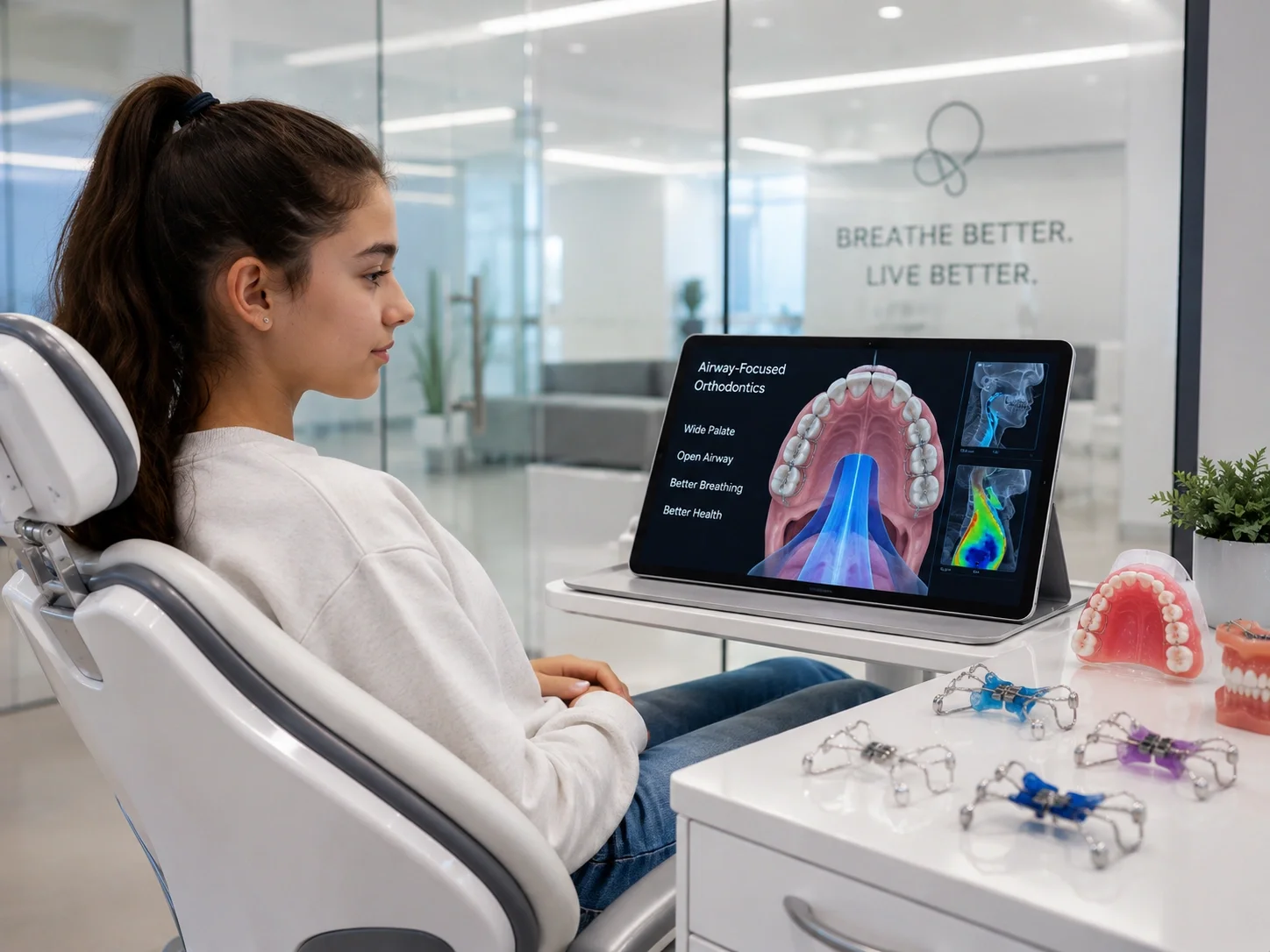
CBCT 3D Imaging
We see the airway, jaw structure, and nasal passages the way a traditional X-ray simply cannot.
SIGNS WORTH PAYING ATTENTION TO
Patterns We Look for — That Parents Often Notice First.
None of these signs in isolation means something is definitively wrong. But together, or in combination with a parent's instinct, they tell a story worth investigating carefully.
Mouth Breathing
Breathing through the mouth during the day or while sleeping, rather than through the nose.
Snoring or Restless Sleep
Snoring or disturbed sleep in a child — often overlooked as normal when it may not be.
Crowded Teeth Appearing Early
Crowded teeth arriving earlier than expected, which can reflect a jaw that isn't developing wide enough.
Narrow upper jaw
A narrow palate or a smile that seems constricted — both visible signs of structural development patterns.
Chronic congestion
Persistent congestion that doesn't resolve — sometimes structural, not just allergic or seasonal.
Unusual fatigue or difficulty concentrating
A child with plenty of energy who is inexplicably tired or struggling to focus — sometimes a sign of disrupted sleep.
HOW WE APPROACH IT
Every Treatment Plan Starts From Scratch.
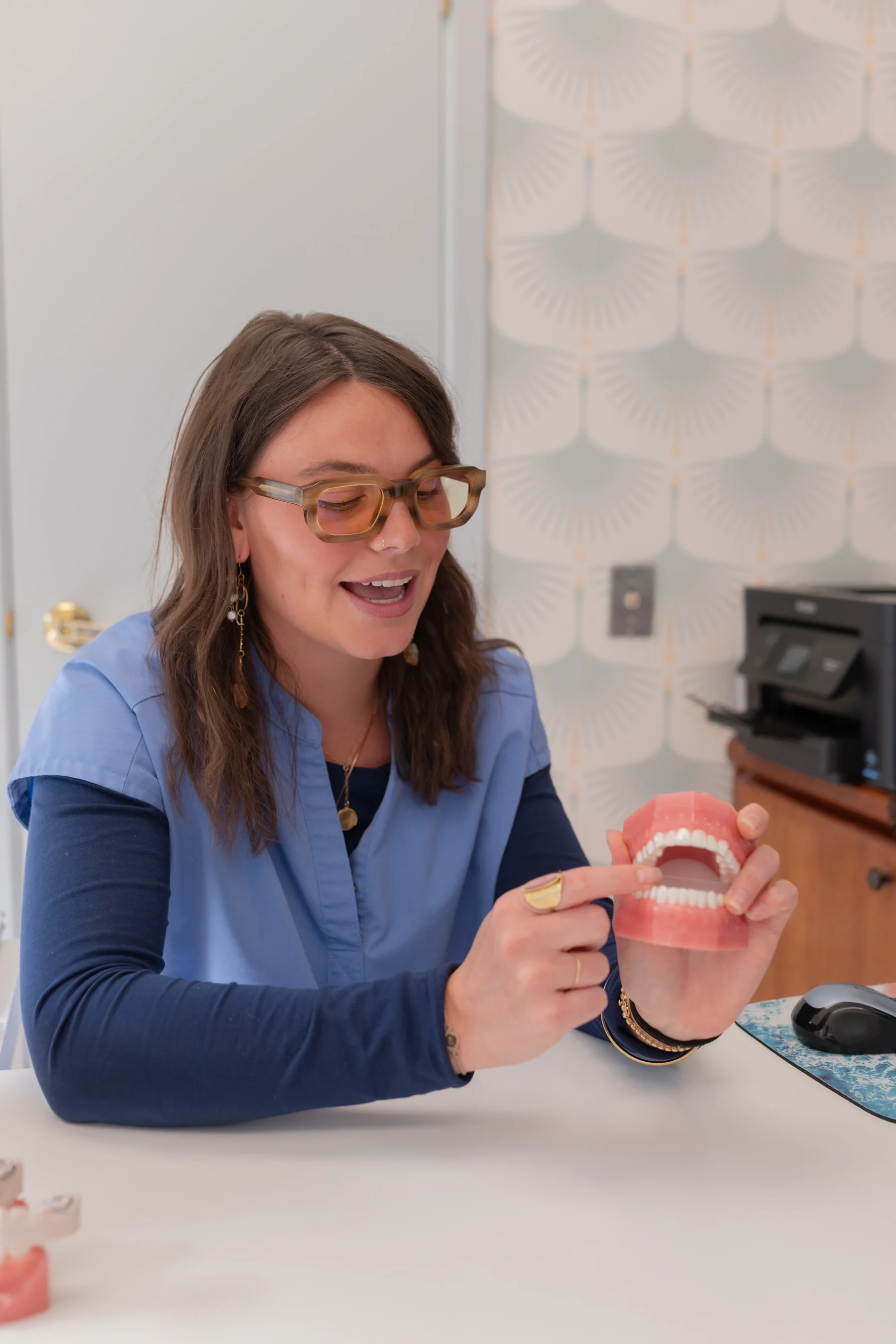
Every airway patient starts with a comprehensive evaluation. We use CBCT imaging — a three-dimensional scan that allows us to see the airway, the jaw structure, and the nasal passages in a way that a traditional X-ray simply cannot. We combine that with intraoral scanning and a thorough clinical examination to build a complete picture before we recommend anything.
From there, treatment is never one-size-fits-all. Airway issues are multifactorial. There is rarely one cause and rarely one fix. Which is exactly why every treatment plan we build starts from scratch.
Palatal expansion
To create space in the upper jaw and improve nasal airway volume where the jaw structure is narrow.
Growth modification appliances
Designed and 3D printed custom in-house for precision and fit, tailored to each patient's anatomy.
Coordinated surgical approach
In some cases, a coordinated approach with surgical partners produces the most comprehensive and lasting outcome.
Tongue ties — a thoughtful approach
A frenum is not inherently problematic. Whether a frenectomy is indicated depends entirely on how it affects function for that individual patient. We work closely with myofunctional therapists who evaluate tongue function and guide that conversation. We want every intervention to be genuinely necessary and genuinely helpful.
WE DON'T WORK ALONE
Getting Airway Care Right Requires a Team.
"I'm just one piece of the puzzle."
— Dr. Katie Bullwinkel, DMD, MS
We've spent years building relationships with the ENTs, sleep physicians, oral surgeons, pediatricians, and allergists who share our commitment to looking at the whole patient.
When you come to us with an airway concern, we don't work in isolation. We communicate actively with your other providers, share findings, coordinate treatment, and make sure everyone who touches your child's care is working from the same understanding. You shouldn't have to be your own care coordinator. That's our job.
Oral Surgeons
Pediatricians
ENTs
Sleep Physicians
Allergists
Myofunctional Therapists
THIS ISN'T ONLY FOR CHILDREN
Adults Find Their Way Here Too.
Adults find their way to airway-focused orthodontics too, often after years of disrupted sleep, CPAP dependence, declining energy, or a sense that something has never quite been right with their breathing.
For adults with obstructive sleep apnea or significant jaw development concerns, orthodontic intervention — sometimes in coordination with oral surgery — can address the underlying structural causes rather than managing symptoms alone. If you've been told your only option is a CPAP machine and that answer hasn't felt complete to you, it may be worth having a different conversation.
DEEPER CLINICAL DETAIL
For Those WHO Want to Understand the Science.
We believe informed patients make better partners in their own care. Here's the clinical detail behind the patterns and treatments described on this page.
-
When a child breathes through their mouth instead of their nose over an extended period, it changes the forces acting on the developing jaw. The tongue, which should rest against the palate and help shape it from the inside, drops to the floor of the mouth. Without that gentle pressure, the upper jaw can grow narrow and high rather than wide and flat. Crowded teeth are often the first visible sign, but the underlying issue is structural.
-
Sleep disordered breathing in children exists on a spectrum from primary snoring to upper airway resistance syndrome to obstructive sleep apnea. Children don't always present the way adults do. Rather than obvious daytime sleepiness, a child with disrupted sleep might show up as hyperactive, inattentive, or struggling academically. If your child snores regularly, sleeps restlessly, or wakes frequently, it's worth a conversation.
-
For adults with obstructive sleep apnea, the airway narrows or collapses during sleep, interrupting breathing and fragmenting rest. Orthodontic treatment, particularly when combined with maxillary expansion or surgical jaw advancement, can address the structural contributors to airway obstruction in ways that behavioral interventions alone cannot.
-
Maxillary skeletal expansion describes a category of treatment that uses a palatal appliance to widen the upper jaw at the skeletal level, creating more space both for the teeth and for the nasal airway above. MSE, MARPE, and DOME are specific techniques within this category, each with particular applications depending on the patient's age, anatomy, and treatment goals. These are not the same as the removable expanders many adults remember from their own childhood orthodontics. They are precise, custom-designed appliances anchored to create controlled, stable expansion.
-
In some cases, particularly for adults or older adolescents whose jaw growth is complete, orthognathic surgery in combination with orthodontic treatment offers the most comprehensive solution for significant skeletal discrepancies affecting the airway. We work closely with trusted oral surgeons in Charleston and beyond to coordinate every aspect of combined surgical-orthodontic care from start to finish.
Your Instinct Brought You Here.
We'll Take It From There.
A complimentary consultation is the right first step. We'll take the time to listen, to look at the whole picture, and to give you honest answers — whatever those turn out to be. There's no pressure and no predetermined outcome. Just a conversation worth having.